
Your Custom Text Here
Governor Hogan Responds to I-270, I-495 Protesters Worried About Homes
A big concern of those living near I-270 and I-495 is the prospect homes and neighborhoods being paved over to make room for Governor Hogan's huge highway project. The Governor proposes adding as many as four lanes to both highways. This has a lot of local residents anxious about the impacts on their homes, neighborhoods and communities, since widening the highways, which run right up against neighborhoods and property lines, would seem to require taking down homes to make room for more lanes.
And according to the Montgomery County Planning Committee, the State's "Managed Lanes Study Area" will ultimately evaluate properties and resources within approximately 300 feet of the existing I-495 and I-270 highway centerline, which certainly suggests that, in the end, stuff would have to be moved out of the way.
So protestors from neighborhoods next to and near I-495 and I-270 arranged themselves along the Labor Day Parade routes in Kensington and Gaithersburg MD. I had a chance to ask the Governor about the risk to homes along the highways. Here's the video (apologies for the very out-of-frame cinematography here):
While we're glad that the Governor told a protester this in the middle of a parade, we'll all feel a lot more secure in our homes' and neighborhoods future if he would issue a formal statement saying so, and making clear to bidders on the project that they will not be able to use eminent domain to seize property. Because as these maps show, there are a lot of homes in the "Study Area". Then we'll all be able to relax.
What Homes are Inside the “Study Area” for Widening I-270 and I-495?
One of the biggest questions concerning Governor Hogan’s plan to widen I-270 and I-495 is “How many and whose homes will be seized and paved over in order to add lanes?” I’ve starting mapping neighborhoods along I-270 and I-495, marking the boundaries of the State’s study area.
UPDATE (Nov 3, 2018) The Maryland-National Parks and Planning Commission just posted a searchable online map showing the extent of the current rights-of-way (ROW) for I-270 and I-495. Currently, the Maryland Department of Transportation (MDOT) is saying it intends to keep any changes to the roads within the existing ROW. You can use the map to see whether properties would be affected - if MDOT sticks to that promise. If you haven't already, please sign our petition calling on Governor Hogan to direct MDOT to reject any proposal which would involve taking homes or property.
One of the most persistent questions that County and City officials, citizen groups and citizens themselves have had about plans to widen I-270 and I-495 has been “just how much wider are we talking about?”
But the State has so far refused to provide any concrete answers, even when directly questioned. As the Maryland Transit Opportunities Coalition (MTOC) highlights, State officials refused to answer questions from the Montgomery County Planning Council during a recent briefing. When MTOC asked for the information under the Maryland Public Information Act the State responded that the non-profit citizen group would have to pony up over $6,000 if they wanted a response. That’s a pretty steep price to pay for information generated with taxpayer dollars that could result in taxpayer homes being torn down.
But State officials have been keen to avoid providing any specifics about how much the roads might need to be widened. Over the course of eleven public meetings and briefings, the State hasn’t once revealed any concrete information about how much wider the highways would need to be in order to accommodate new toll lanes.
Adding to the confusion created by the State holding back on telling the public how much wider the road would get, we’re now getting conflicting statements about whether the highways even would expand. When he announced the plan nearly a year ago, Governor Hogan explained that “These three massive, unprecedented projects to widen I-495, I-270 and MD 295 will be absolutely transformative…”
But last week, the Washington Post paraphrased Maryland State Highway Administrator Greg Slater as saying that “the state plans to keep any changes within the existing right-of-way.”
I’m no road expert, but it seems like it’d be hard to squeeze four extra lanes into a highway without making it any wider. Hey, if Slater is right, I’ll be thrilled. But until we know for sure, residents need to know who might be affected.
What we do know is that the State’s Managed Lanes study will “ultimately evaluate properties and resources within approximately 300 feet of the existing I-495 and I-270 highway centerline.” Now, that doesn’t mean they are going to pave over everything in that area. But they are studying something, and until the State decides to come forward with concrete information, at least we can get started looking at possible impacts using the 300 feet figure.
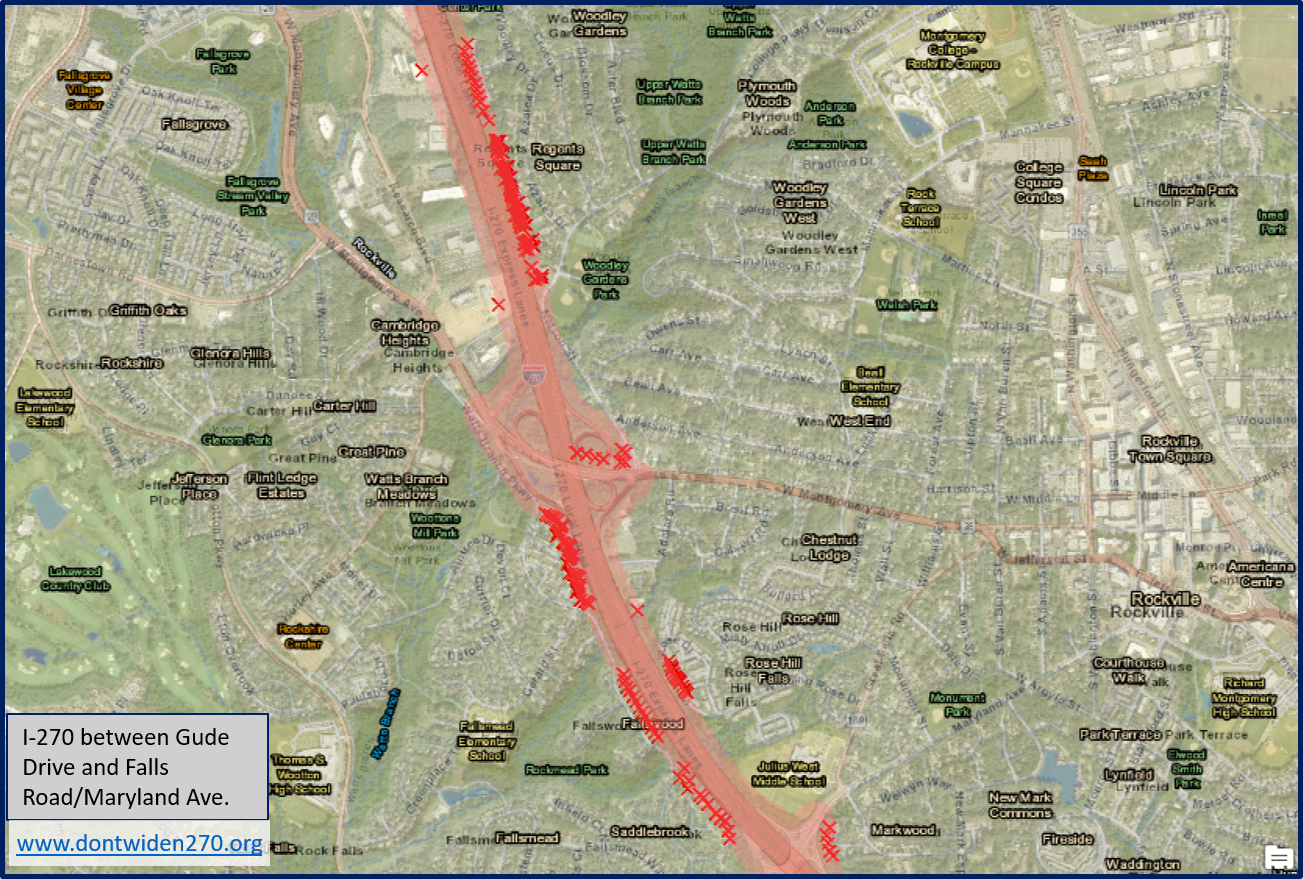
To that end, I’ve started producing GIS maps along the highway, highlighting the area the State is studying. I’ve done my best to show the buffer extending 300 feet from the centerline of the highway on each side, and what homes and businesses may be in that area. It’s a lot of mapping, so I’m going in segments. The first set I’m posting show I-270 from south of Gude Road to Falls Road/Maryland Avenue. I’ll post more areas and neighborhoods as I get them mapped.

The stretch of I-270 between Gude Drive and Falls Road/Maryland Avenue is home to many neighborhoods within the study area. More detailed illustrations of individual neighborhoods are below. (PS Let me know if I got any neighborhood names wrong.)


Maryland Has Widened I-270 Before. How'd That Work Out?
The proposal to widen I-270 and I-495 to relieve traffic congestion ignores a fundamental law of traffic: wider roads generate their own traffic. This has been demonstrated repeatedly, around the U.S. and around the world, to such a degree that Maryland's transportation planners should be required to explain why their proposals to widen two of the region's most congested roadways will somehow be exempted from this bedrock principle of traffic.
After all, our transportation planners got a first-hand lesson in this law the last time they widened I-270 to relieve traffic. As the Washington Post reported in 1999, less than eight years after a $200 million project that widened I-270 to up to twelve lanes in some places,
the highway has again been reduced to what one official called "a rolling parking lot." Traffic on some segments already has exceeded the levels projected for 2010.
Robert S. McGarry, Montgomery County's Transportation Director at the time, had pushed hard for the expansion. But he later admitted that "I personally thought [congestion relief] would last much longer than this...I just didn't in my wildest dreams think it would fill up that fast."
Maryland hasn't been alone experiencing this counter-intuitive dynamic, known as "induced demand." In 2008, Texas completed a $2.8 billion project widening I-10 to 23 lanes. Congestion declined for the first few years, but started going up again between 2011 and 2014, according to a study of local traffic data.
California's $1.6 billion expansion of 410 has hardly had any time to relieve congestion - just a year after completion, average commute time is actually slower than it was before the highway was widened.
There's plenty of research indicating the experiences of these states are the rule, not the exception. In 2014, a pair of economists set out to test the idea that more lanes reduce traffic, by comparing highway capacity and vehicle traffic in 228 metro areas around the U.S. As Vox reported,
They found a one-to-one correlation: the more highway capacity a metro area had, the more miles its vehicles traveled on them. A 10 percent increase in capacity, for instance, meant a 10 percent increase in vehicle miles, on average.
When they looked at changes in highway capacity and vehicle miles traveled, they found the same one to one effect. Their findings have been replicated in other countries as well.
A 2015 research report by the National Center for Sustainable Transportation noted that "Numerous studies have examined the effectiveness of this approach and consistently show that adding capacity to roadways fails to alleviate congestion for long because it actually increases vehicle miles traveled (VMT)."
The evidence of our own experience and from around the nation and world make clear that any short-term congestion relief can be expected to be lost within a few years, and traffic will likely get even worse.
The State of Maryland must not be allowed to blind itself to reality, and put the the lives and families and neighborhood communities at risk, in pursuit of what has been clearly shown to be a solution that doesn't work, or that makes the problem worse.